Cyclone Seeder Bag
Title
Cyclone Seeder Bag
Subject
Farming in the nineteenth century was hard work. Agriculture was labor intensive, and farmers often planted seeds by hand. The Cyclone Seeder Bag made seeding easier. The farmer held the device and turned a crank to spread the seeds. This tool was useful in many environments, including in Nebraska. The seeder bag saved farmers time and labor and paved the way for future inventions. In the twentieth century, machine power largely replaced human labor. Mechanization increased crop yields and farm sizes, and it made agriculture a global industry. Overproduction resulted in the exportation of excess crops into the world market. The consequences of these changes varied but included land clearance and loss of plant and animal species. Mechanization improved farmers’ lives but had lasting effects on the environment.
Description
The late-nineteenth century was a moment of profound transition in the history of Nebraska. This period encompassed the largest migration of people in United States history and included the movement of millions of farmers to the Great Plains (Billington and Ridge, 2001). Over one million people migrated to Nebraska between 1850 and 1890, drawn by the promise of agricultural fertility (Hervey, 1903). About 600,000 people settled in the state in the 1880s alone. As a result of this large migration, 430,000,000 acres were settled, and 225,000,000 acres were cultivated between 1870 and 1900 with those settling in humid eastern Nebraska focusing on arable agriculture (Billington and Ridge, 2001; Hervey, 1903). Nebraska settlers viewed the region as a land of possibility with the potential to double its crop yield under proper cultivation (Hervey, 1903).
However, farmers during the nineteenth century were limited by inefficient seeding practices. The existing methods of seeding had been employed since ancient times and consisted of a farmer seeding by hand, dropping seeds from a cloth sack into prepared rows (Conkin, 2008; Lazor, 2013). The invention of the Cyclone Seeder Bag and other mechanical broadcasters reduced the labor necessary for seeding. Though it may seem small, the Cyclone Seeder was part of a much larger mechanization of agriculture during the turn of the twentieth century that had profound social and environmental consequences. The Cyclone Seeder Bag is important in the environmental history of Nebraska because it symbolizes the labor-saving costs of mechanization that led to the globalization of agriculture and regional changes to land clearance trends characteristic of the Anthropocene.
Samuel S. Speicher invented the Cyclone Seeder Bag in 1870. Speicher was an Indiana farmer driven by his commitment to optimize agricultural efficiency. Speicher had already devised a hand-full of labor-saving devices similar to the seeder bag intended for his own agricultural use. Realizing the demand of a tool capable of expediting the sowing process, Speicher created a manual seeder device efficient in the consistent disbursement of seeds across a broad region of land. From a little shop on his farm, Speicher manufactured roughly 150 seeder bags per year. Demand was robust, and by 1880, Speicher moved his business to Northern Manchester, Indiana, where he produced 2,000 to 5,000 seeder bags annually. By 1890, he was manufacturing 30,000 to 40,000 seeders per year at his new facility in Urbana, Indiana. Although largely forgotten today, Speicher’s Cyclone Seeder Bag was a common item on American and international farms by the nineteenth century, and one example has found its way to the Durham Museum collection (Weesner, 1914).
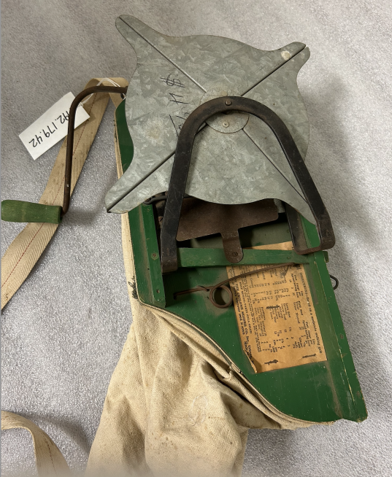
The object in the Durham Museum collection is representative of the tool. Typically made from heavy duty canvas, the seeder bag portion plays a critical role in the hand powered device. Adjustable straps attached to the seeder bag affix the machine to the user’s shoulder, allowing for a hands-free approach in hauling the seeder bag during the seed dispersal procedure (Lazor, 2013). The seeder bag operates as the seed chamber, which feeds a metering aperture that deposits the seeds into a rotating metal ribbed disk. From there, the seeds are dispersed in a wide fan-shaped arrangement by the operator’s hand, which cranks the metal disk. Figure 1 depicts an image of the Cyclone Seeder Bag from the Durham Museum in Omaha, Nebraska. The Cyclone Seeder Bag’s configuration and light form allows the operator to maneuver with ease while simultaneously regulating the dispersal of seeds (Larson, 1980).
The Cyclone Seeder Bag had various advantages, specifically in small-scale agriculture and land restoration. During the 20th century, the seeder bag evolved into a critical device in the dispersal of seeds among areas in which use of heavy equipment was limited. Additionally, the device was particularly helpful in sowing on uneven landscapes or inclined surfaces, both demanding greater regulation and systematic approach than sowing by hand. Farmers and foresters particularly found this device useful for the equal covering of areas unreachable for heavier equipment, such as tractors (Hardware, 1906).
Although the Cyclone Seeder Bag was effective for uneven landscapes, inclined surfaces, and smaller plots, it was not very efficient in sowing large-scale fields. Compared to mechanized seed spreaders mounted on vehicles, the hand-cranked seeder bag approach was more labor-intensive. Likewise, the seeder used a greater number of seeds, which resulted in overapplication of seeds. Despite these disadvantages, the Cyclone Seeder Bag remained an effective tool for seeding needs for when alternative practices proved impractical (Larson, 1980). Although the Cyclone Seeder Bag saved labor relative to hand sowing, it was merely one step in the process of agricultural mechanization.
Omaha evolved into an agricultural hotspot for its’ large-scale corn production as it is located in the region referred to as the ‘Corn Belt.’ The extension of farms and mechanization in the Midwest gave farmers the opportunity to maximize crop productivity, allowing Nebraska to become a dominant agricultural region (Edwards, 2004). Devices such as the Cyclone Seeder Bag promoted this growth, further making it more effective in seed dispersal of regions in which other machines were not as efficient. The evolution of agricultural practices in Nebraska developed into a central part of Omaha’s economy, strengthening its regional impact and adjusting to contemporary agricultural equipment and environmental obstacles (Sanford, 2007). As agriculture expansion moved to the West, the open nature of Nebraska’s area permitted the integration of innovative technology. Mechanized devices like the Cyclone Seeder Bag substantially enhanced productivity, allowing agriculture to excel across both the region and the economy.
The Cyclone Seeder Bag was one of the first in a long line of innovations that reduced the labor agriculture required of farmers. Mechanical broadcasters like the seeder bag led to innovations such as battery powered rotary spreaders that could be attached to a wagon or trunk and later drills/planters that deposited the seeds directly into a hole made in the ground (Conkin, 2008; Lazor, 2013). The mechanization of agriculture reduced the labor force necessary for seeding and other processes. Energy historian Vaclav Smil has argued that “massive reduction of labor force has been the most consequential economic impact of agricultural mechanization” (Smil, 2021). The replacement of human power with mechanical power saved farmers millions of hours of farm work to produce the same yield of crop (Perelman, 1973). While Speicher’s innovations may seem simple, his motivation to create a labor-saving device paved the way for innovations that have changed agriculture across the world.
The labor-saving effects of agricultural mechanization allowed farmers to increase the size of their farms and still input the same amount of labor. Mechanization not only allowed the average American farm to triple in size but also encouraged the restructuring of farm enterprises (Gardner, 2002; Smil, 2021). Figure 2 shows the percent change in the average size of farms in eastern Nebraska and western Iowa, including Douglas County and Omaha, during the 20th century (Retallick and Gildersleeve, 1967). As farmers continued to increase the size of their farms, more land was cleared for agricultural use. Mechanization has changed the shape of the agricultural landscape and the transformation of natural ecosystems is an indicator of humans’ impact on the environment (Handbook on the Human Impact, 2021; Smil, 2015).
The most common and extensive form of anthropogenic land clearance was the conversion of forests, grasslands, and wetlands into crop fields, which peaked in the early twentieth century. The transformation of several hundred acres of grassland was able to be cleared per family across the Great Plains (Cunfer, 2005; Smil, 2015). While the conversion of land began with the advent of agriculture, land clearance increased exponentially in the late nineteenth and early twentieth centuries. Figure 3 shows the total amount of land used for cropland in North America from 1600 to 2023 (Ritchie and Roser, 2024). Conversion of grassland to cropland not only reduced the diversity of grass and plant species in the area but also decreased the vegetation needed by animals for habitats and consumption. Large-scale farming systems also led to a decrease in the genetic diversity of the crops planted which is necessary for plant breeding to prevent pests and disease and to adapt to future farming practices and climate change (Committee on Twenty-First Century Systems Agriculture, 2010). The mechanization of agriculture has changed humans’ relationship with the land leading to a farming system that prioritizes high yields over sustainable land use practices.
As the size of farms and crop yields increased, American agriculture shifted from more subsistence and small-scale farming to large-scale farming systems rooted in capitalism. Historian Donald Worster argues that nature can be considered capital and that farmers’ use of it for personal advancement and wealth should not just be allowed but encouraged (Worster, 1979). Mechanized agriculture can be explored as a series of inputs and outputs in which the inputs are land, labor, and capital and the outputs are harvested crops and livestock products (Gardner, 2002). Changes in agricultural technology through mechanisms such as reduction of labor have resulted in a decrease of these inputs and/or an increase in outputs. The large-scale agriculture that was made possible by mechanization increased productivity with fewer labor costs. It was thus a “capital-saving innovation” that provided significant economic incentives (Gardner, 2002). Agricultural innovations did not emerge out of scientific and technological progress but out of a need to increase productivity as farms became immersed in the global market. Historian Joshua Brinkman has described this change as the shift to a “rural capitalistic modernity” defined by farmers acting as independent capitalists through the use of technology at a time where mechanization was a symbol of the industrialist American culture (Brinkman, 2024). Mechanization of agriculture was not just a method in which farmers could save labor but became a tool for increasing productivity and profit.
As farmers immersed themselves in the world of capitalism and as agricultural productivity increased, there were more crops available for exchange in the global market. Decreases in the amount of labor agriculture required and increases in farm sizes led to an overproduction of crops in the United States. As domestic products became abundant, the preferred method was the export of farm products into the world market (Paarlberg and Paarlberg, 2001). By the late 20th century, the United States used more than 20% of its cropland acreage for exports (Perelman, 1973). Increased crop yields and globalization of agriculture have had significant positive social implications. Higher productivity due to mechanization resulted in the production of more food and lower food prices (Handbook on the Human Impact, 2021). While increased food production, cheaper prices, and exporting of food has helped to feed the planet, it has also left a substantial impact on the environment, both in terms of land clearance and energy usage. Agriculture is thought of as being an energy producing industry, harvesting solar energy from plants, but due to mechanization, it used more petroleum than any other industry by the late 20th century (Perelman, 1973).
Many scholars argue that the Anthropocene began during the postwar Great Acceleration as it is marked by dramatic increases in not only population and urbanization but also human impacts on the environment. The mechanization of agriculture parallels the themes of the Great Acceleration as it has led to increases in technological innovations, size of farms, land clearance, crop yields, farm product exports, and energy utilization. Mechanization has transformed agriculture from a local or regional enterprise into a global industry. Increased use of machinery in agriculture and increased productivity resulted in the collectivization and specialization of agriculture and reduced labor needs resulted in urbanization (McNeill, 2021). The mechanization of agriculture is connected to the Anthropocene through its environmental impact and increase in land clearance, but also through the global consequences of agriculture’s emergence into the global, capitalist market.
The Cyclone Seeder Bag may come across as a minor chapter in agricultural history, but it marks a defining moment in the transition to mechanized labor. Carried by nineteenth century farmers, the canvas bag represents a broader transformation in agriculture; a shift towards mechanization that redefined human interaction with the environment. The consequences of industrial agriculture, such as climate change, loss of biodiversity, and land degradation, serve as a reminder of the balance between progress and sustainability. This device played a critical role in shaping Omaha’s agricultural landscape, marking a pivotal period in the Anthropocene when mechanization began to transform the environment. As mechanization advanced, it increased productivity while underscoring the growing human impact on the land, connecting Omaha’s agricultural growth to global shifts in land use and environmental change. The Cyclone Seeder Bag represents more than just a tool; it exemplifies how small innovations ripple through history, influencing the environment, economies, and societies.
However, farmers during the nineteenth century were limited by inefficient seeding practices. The existing methods of seeding had been employed since ancient times and consisted of a farmer seeding by hand, dropping seeds from a cloth sack into prepared rows (Conkin, 2008; Lazor, 2013). The invention of the Cyclone Seeder Bag and other mechanical broadcasters reduced the labor necessary for seeding. Though it may seem small, the Cyclone Seeder was part of a much larger mechanization of agriculture during the turn of the twentieth century that had profound social and environmental consequences. The Cyclone Seeder Bag is important in the environmental history of Nebraska because it symbolizes the labor-saving costs of mechanization that led to the globalization of agriculture and regional changes to land clearance trends characteristic of the Anthropocene.
Samuel S. Speicher invented the Cyclone Seeder Bag in 1870. Speicher was an Indiana farmer driven by his commitment to optimize agricultural efficiency. Speicher had already devised a hand-full of labor-saving devices similar to the seeder bag intended for his own agricultural use. Realizing the demand of a tool capable of expediting the sowing process, Speicher created a manual seeder device efficient in the consistent disbursement of seeds across a broad region of land. From a little shop on his farm, Speicher manufactured roughly 150 seeder bags per year. Demand was robust, and by 1880, Speicher moved his business to Northern Manchester, Indiana, where he produced 2,000 to 5,000 seeder bags annually. By 1890, he was manufacturing 30,000 to 40,000 seeders per year at his new facility in Urbana, Indiana. Although largely forgotten today, Speicher’s Cyclone Seeder Bag was a common item on American and international farms by the nineteenth century, and one example has found its way to the Durham Museum collection (Weesner, 1914).
The object in the Durham Museum collection is representative of the tool. Typically made from heavy duty canvas, the seeder bag portion plays a critical role in the hand powered device. Adjustable straps attached to the seeder bag affix the machine to the user’s shoulder, allowing for a hands-free approach in hauling the seeder bag during the seed dispersal procedure (Lazor, 2013). The seeder bag operates as the seed chamber, which feeds a metering aperture that deposits the seeds into a rotating metal ribbed disk. From there, the seeds are dispersed in a wide fan-shaped arrangement by the operator’s hand, which cranks the metal disk. Figure 1 depicts an image of the Cyclone Seeder Bag from the Durham Museum in Omaha, Nebraska. The Cyclone Seeder Bag’s configuration and light form allows the operator to maneuver with ease while simultaneously regulating the dispersal of seeds (Larson, 1980).
The Cyclone Seeder Bag had various advantages, specifically in small-scale agriculture and land restoration. During the 20th century, the seeder bag evolved into a critical device in the dispersal of seeds among areas in which use of heavy equipment was limited. Additionally, the device was particularly helpful in sowing on uneven landscapes or inclined surfaces, both demanding greater regulation and systematic approach than sowing by hand. Farmers and foresters particularly found this device useful for the equal covering of areas unreachable for heavier equipment, such as tractors (Hardware, 1906).
Although the Cyclone Seeder Bag was effective for uneven landscapes, inclined surfaces, and smaller plots, it was not very efficient in sowing large-scale fields. Compared to mechanized seed spreaders mounted on vehicles, the hand-cranked seeder bag approach was more labor-intensive. Likewise, the seeder used a greater number of seeds, which resulted in overapplication of seeds. Despite these disadvantages, the Cyclone Seeder Bag remained an effective tool for seeding needs for when alternative practices proved impractical (Larson, 1980). Although the Cyclone Seeder Bag saved labor relative to hand sowing, it was merely one step in the process of agricultural mechanization.
Omaha evolved into an agricultural hotspot for its’ large-scale corn production as it is located in the region referred to as the ‘Corn Belt.’ The extension of farms and mechanization in the Midwest gave farmers the opportunity to maximize crop productivity, allowing Nebraska to become a dominant agricultural region (Edwards, 2004). Devices such as the Cyclone Seeder Bag promoted this growth, further making it more effective in seed dispersal of regions in which other machines were not as efficient. The evolution of agricultural practices in Nebraska developed into a central part of Omaha’s economy, strengthening its regional impact and adjusting to contemporary agricultural equipment and environmental obstacles (Sanford, 2007). As agriculture expansion moved to the West, the open nature of Nebraska’s area permitted the integration of innovative technology. Mechanized devices like the Cyclone Seeder Bag substantially enhanced productivity, allowing agriculture to excel across both the region and the economy.
The Cyclone Seeder Bag was one of the first in a long line of innovations that reduced the labor agriculture required of farmers. Mechanical broadcasters like the seeder bag led to innovations such as battery powered rotary spreaders that could be attached to a wagon or trunk and later drills/planters that deposited the seeds directly into a hole made in the ground (Conkin, 2008; Lazor, 2013). The mechanization of agriculture reduced the labor force necessary for seeding and other processes. Energy historian Vaclav Smil has argued that “massive reduction of labor force has been the most consequential economic impact of agricultural mechanization” (Smil, 2021). The replacement of human power with mechanical power saved farmers millions of hours of farm work to produce the same yield of crop (Perelman, 1973). While Speicher’s innovations may seem simple, his motivation to create a labor-saving device paved the way for innovations that have changed agriculture across the world.
The labor-saving effects of agricultural mechanization allowed farmers to increase the size of their farms and still input the same amount of labor. Mechanization not only allowed the average American farm to triple in size but also encouraged the restructuring of farm enterprises (Gardner, 2002; Smil, 2021). Figure 2 shows the percent change in the average size of farms in eastern Nebraska and western Iowa, including Douglas County and Omaha, during the 20th century (Retallick and Gildersleeve, 1967). As farmers continued to increase the size of their farms, more land was cleared for agricultural use. Mechanization has changed the shape of the agricultural landscape and the transformation of natural ecosystems is an indicator of humans’ impact on the environment (Handbook on the Human Impact, 2021; Smil, 2015).
The most common and extensive form of anthropogenic land clearance was the conversion of forests, grasslands, and wetlands into crop fields, which peaked in the early twentieth century. The transformation of several hundred acres of grassland was able to be cleared per family across the Great Plains (Cunfer, 2005; Smil, 2015). While the conversion of land began with the advent of agriculture, land clearance increased exponentially in the late nineteenth and early twentieth centuries. Figure 3 shows the total amount of land used for cropland in North America from 1600 to 2023 (Ritchie and Roser, 2024). Conversion of grassland to cropland not only reduced the diversity of grass and plant species in the area but also decreased the vegetation needed by animals for habitats and consumption. Large-scale farming systems also led to a decrease in the genetic diversity of the crops planted which is necessary for plant breeding to prevent pests and disease and to adapt to future farming practices and climate change (Committee on Twenty-First Century Systems Agriculture, 2010). The mechanization of agriculture has changed humans’ relationship with the land leading to a farming system that prioritizes high yields over sustainable land use practices.
As the size of farms and crop yields increased, American agriculture shifted from more subsistence and small-scale farming to large-scale farming systems rooted in capitalism. Historian Donald Worster argues that nature can be considered capital and that farmers’ use of it for personal advancement and wealth should not just be allowed but encouraged (Worster, 1979). Mechanized agriculture can be explored as a series of inputs and outputs in which the inputs are land, labor, and capital and the outputs are harvested crops and livestock products (Gardner, 2002). Changes in agricultural technology through mechanisms such as reduction of labor have resulted in a decrease of these inputs and/or an increase in outputs. The large-scale agriculture that was made possible by mechanization increased productivity with fewer labor costs. It was thus a “capital-saving innovation” that provided significant economic incentives (Gardner, 2002). Agricultural innovations did not emerge out of scientific and technological progress but out of a need to increase productivity as farms became immersed in the global market. Historian Joshua Brinkman has described this change as the shift to a “rural capitalistic modernity” defined by farmers acting as independent capitalists through the use of technology at a time where mechanization was a symbol of the industrialist American culture (Brinkman, 2024). Mechanization of agriculture was not just a method in which farmers could save labor but became a tool for increasing productivity and profit.
As farmers immersed themselves in the world of capitalism and as agricultural productivity increased, there were more crops available for exchange in the global market. Decreases in the amount of labor agriculture required and increases in farm sizes led to an overproduction of crops in the United States. As domestic products became abundant, the preferred method was the export of farm products into the world market (Paarlberg and Paarlberg, 2001). By the late 20th century, the United States used more than 20% of its cropland acreage for exports (Perelman, 1973). Increased crop yields and globalization of agriculture have had significant positive social implications. Higher productivity due to mechanization resulted in the production of more food and lower food prices (Handbook on the Human Impact, 2021). While increased food production, cheaper prices, and exporting of food has helped to feed the planet, it has also left a substantial impact on the environment, both in terms of land clearance and energy usage. Agriculture is thought of as being an energy producing industry, harvesting solar energy from plants, but due to mechanization, it used more petroleum than any other industry by the late 20th century (Perelman, 1973).
Many scholars argue that the Anthropocene began during the postwar Great Acceleration as it is marked by dramatic increases in not only population and urbanization but also human impacts on the environment. The mechanization of agriculture parallels the themes of the Great Acceleration as it has led to increases in technological innovations, size of farms, land clearance, crop yields, farm product exports, and energy utilization. Mechanization has transformed agriculture from a local or regional enterprise into a global industry. Increased use of machinery in agriculture and increased productivity resulted in the collectivization and specialization of agriculture and reduced labor needs resulted in urbanization (McNeill, 2021). The mechanization of agriculture is connected to the Anthropocene through its environmental impact and increase in land clearance, but also through the global consequences of agriculture’s emergence into the global, capitalist market.
The Cyclone Seeder Bag may come across as a minor chapter in agricultural history, but it marks a defining moment in the transition to mechanized labor. Carried by nineteenth century farmers, the canvas bag represents a broader transformation in agriculture; a shift towards mechanization that redefined human interaction with the environment. The consequences of industrial agriculture, such as climate change, loss of biodiversity, and land degradation, serve as a reminder of the balance between progress and sustainability. This device played a critical role in shaping Omaha’s agricultural landscape, marking a pivotal period in the Anthropocene when mechanization began to transform the environment. As mechanization advanced, it increased productivity while underscoring the growing human impact on the land, connecting Omaha’s agricultural growth to global shifts in land use and environmental change. The Cyclone Seeder Bag represents more than just a tool; it exemplifies how small innovations ripple through history, influencing the environment, economies, and societies.
Creator
McKenna Blaine, Hannah Ladwig
Source
Billington, Ray Allen, and Martin Ridge. Westward Expansion: A History of the American Frontier. 6th ed., University of New Mexico Press, 2001. Google Books, https://www.google.com/books/edition/Westward_Expansion/YoV-k7VcyZ0C?hl=en&gbpv=0.
Brinkman, Joshua T. American Farming Culture and the History of Technology. Taylor & Francis, 2024. Google Books, www.google.com/books/edition/American_Farming_Culture_and_the_History/0yH7EAAAQBAJ?hl=en&gbpv=0.
Committee on Twenty-First Century Systems Agriculture. Toward Sustainable Agricultural Systems in the 21st Century. National Academies Press, 2010. Google Books, www.google.com/books/edition/Toward_Sustainable_Agricultural_Systems/DjRkAgAAQBAJ?hl=en&gbpv=1&dq=-HISTORIES%2BOF%2BAGRICULTURE%2BIN%2BTHe%2B
Conkin, Paul K. A Revolution Down on the Farm: The Transformation of American Agriculture Since 1929. University Press of Kentucky, 2008. Google Books, www.google.com/books/edition/A_Revolution_Down_on_the_Farm/J1xyUPpkloMC?hl=en&gbpv=0&kptab=overview.
Cunfer, Geoff. On the Great Plains: Agriculture and Environment. Texas A&M University Press, 2005. Google Books, https://www.google.com/books/edition/On_The_Great_Plains/__01fkRdOcEC?hl=en&gbpv=0.
Edwards, Lewis Clifford. History of Richardson County, Nebraska. Unigraphic, 2004. Google Books, www.google.com/books/edition/History_of_Richardson_County_Nebraska/yJ4yAQAAMAAJ?hl=en&gbpv=1&dq=manufacturing%2Bin%2Bnebraska%2B1900s&printsec=frontcover.
Gardner, Bruce L. American Agriculture in the Twentieth Century: How It Flourished and What It Cost. Harvard University Press, 2002. Google Books, www.google.com/books/edition/American_Agriculture_in_the_Twentieth_Ce/9UgvEAAAQBAJ?hl=en&gbpv=0.
Handbook on the Human Impact of Agriculture. Edited by Harvey S. James, Edward Elgar Publishing, 2021. Google Books, www.google.com/books/edition/Handbook_on_the_Human_Impact_of_Agricult/b2IzEAAAQBAJ?hl=en&gbpv=1&dq=environmental%2Beffects%2Bof%2Bagricultural%2Bmechanization%2Bin%2BUS&printsec=frontcover.
Hardware: Devoted to the American Hardware Trade. Vol. 33, The New York Public Library, 1906. Google Books, www.google.com/books/edition/Hardware/hZk7AQAAMAAJ?hl=en&gbpv=1&kptab=overview.
Hervey, George Washington, ed., A Condensed History of Nebraska for Fifty Years to Date: Profusely and Appropriately Illustrated.Omaha: Nebraska Farmer Company, 1903. Google Books, www.google.com/books/edition/A_Condensed_History_of_Nebraska_for_Fift/ZBo1AQAAMAAJ?hl=en&gbpv=1&dq=agriculture%2Bin%2Bomaha%2Bnebraska%2B1800s&printsec=frontcover.
Larson, John E., and Richard Hallman. Equipment for Reforestation and Timber Stand Improvement. Forest Service, Equipment Development Center: Fort Missoula, 1980. Google Books, www.google.com/books/edition/Equipment_for_Reforestation_and_Timber_S/0gUnumr86PgC?hl=en&gbpv=1.
Lazor, Jack. Organic Grain Grower: Small-Scale, Holistic Grain Production for the Home and Market Producer. Chelsea Green Publishing, 2013. Google Books, www.google.com/books/edition/The_Organic_Grain_Grower/6vyGAgAAQBAJ?hl=en&gbpv=1.
McNeill, J. R. Something New Under the Sun. W.W. Norton & Company, Incorporated, 2001. Google Books, https://www.google.com/books/edition/Something_New_Under_the_Sun/h_NT3RlHH2oC?hl=en&gbpv=0.
Paarlberg, Don, and Philip Paarlberg. The Agricultural Revolution of the 20th Century. Iowa State University Press, 2001.
Perelman, Michael. “Mechanization and the Division of Labor in Agriculture.” American Journal of Agricultural Economics, vol. 55, no. 3, 1973, pp. 523–26. JSTOR, https://doi.org/10.2307/1239138.
Retallick, Harold J., and Charles R. Gildersleeve. “Geographic Background Report No. 01: Omaha’s Agricultural Core Region.” Publications Archives, University of Nebraska at Omaha, 506, 1967. digitalcommons.unomaha.edu/cparpubarchives/506.
Ritchie, Hannah, and Max Roser. “Land Use.” Our World in Data, 16 Feb. 2024, ourworldindata.org/land-use.
Sanford, Albert Hart. The Story of Agriculture in the United States. D.C. Heath, 2007. Google Books, www.google.com/books/edition/The_Story_of_Agriculture_in_the_United_S/-PoNAAAAYAAJ?hl=en&gbpv=0.
Smil, Vaclav. Grand Transitions: How the Modern World Was Made. Oxford University Press, 2021. Google Books, https://www.google.com/books/edition/Grand_Transitions/rrscEAAAQBAJ?hl=en&gbpv=1.
Smil, Vaclav. Harvesting the Biosphere: What We Have Taken from Nature. The MIT Press, 2015. Google Books, https://www.google.com/books/edition/Harvesting_the_Biosphere/DFT5DwAAQBAJ?hl=en&gbpv=0.
Weesner, Clarkson W. “DANIEL E. SPEICHER.” History of Wabash County Indiana, vol. 2, 1914, pp. 939–940, www.nmanchesterhistory.org/biographies-daniel-speicher.html.
Worster, Donald. Dust Bowl: The Southern Plains in the 1930s. Oxford University Press, 1979. Google Books, https://www.google.com/books/edition/Dust_Bowl/8fM-ZWXPe_QC?hl=en&gbpv=1&dq=worster+dust+bowl&printsec=frontcover.
Brinkman, Joshua T. American Farming Culture and the History of Technology. Taylor & Francis, 2024. Google Books, www.google.com/books/edition/American_Farming_Culture_and_the_History/0yH7EAAAQBAJ?hl=en&gbpv=0.
Committee on Twenty-First Century Systems Agriculture. Toward Sustainable Agricultural Systems in the 21st Century. National Academies Press, 2010. Google Books, www.google.com/books/edition/Toward_Sustainable_Agricultural_Systems/DjRkAgAAQBAJ?hl=en&gbpv=1&dq=-HISTORIES%2BOF%2BAGRICULTURE%2BIN%2BTHe%2B
Conkin, Paul K. A Revolution Down on the Farm: The Transformation of American Agriculture Since 1929. University Press of Kentucky, 2008. Google Books, www.google.com/books/edition/A_Revolution_Down_on_the_Farm/J1xyUPpkloMC?hl=en&gbpv=0&kptab=overview.
Cunfer, Geoff. On the Great Plains: Agriculture and Environment. Texas A&M University Press, 2005. Google Books, https://www.google.com/books/edition/On_The_Great_Plains/__01fkRdOcEC?hl=en&gbpv=0.
Edwards, Lewis Clifford. History of Richardson County, Nebraska. Unigraphic, 2004. Google Books, www.google.com/books/edition/History_of_Richardson_County_Nebraska/yJ4yAQAAMAAJ?hl=en&gbpv=1&dq=manufacturing%2Bin%2Bnebraska%2B1900s&printsec=frontcover.
Gardner, Bruce L. American Agriculture in the Twentieth Century: How It Flourished and What It Cost. Harvard University Press, 2002. Google Books, www.google.com/books/edition/American_Agriculture_in_the_Twentieth_Ce/9UgvEAAAQBAJ?hl=en&gbpv=0.
Handbook on the Human Impact of Agriculture. Edited by Harvey S. James, Edward Elgar Publishing, 2021. Google Books, www.google.com/books/edition/Handbook_on_the_Human_Impact_of_Agricult/b2IzEAAAQBAJ?hl=en&gbpv=1&dq=environmental%2Beffects%2Bof%2Bagricultural%2Bmechanization%2Bin%2BUS&printsec=frontcover.
Hardware: Devoted to the American Hardware Trade. Vol. 33, The New York Public Library, 1906. Google Books, www.google.com/books/edition/Hardware/hZk7AQAAMAAJ?hl=en&gbpv=1&kptab=overview.
Hervey, George Washington, ed., A Condensed History of Nebraska for Fifty Years to Date: Profusely and Appropriately Illustrated.Omaha: Nebraska Farmer Company, 1903. Google Books, www.google.com/books/edition/A_Condensed_History_of_Nebraska_for_Fift/ZBo1AQAAMAAJ?hl=en&gbpv=1&dq=agriculture%2Bin%2Bomaha%2Bnebraska%2B1800s&printsec=frontcover.
Larson, John E., and Richard Hallman. Equipment for Reforestation and Timber Stand Improvement. Forest Service, Equipment Development Center: Fort Missoula, 1980. Google Books, www.google.com/books/edition/Equipment_for_Reforestation_and_Timber_S/0gUnumr86PgC?hl=en&gbpv=1.
Lazor, Jack. Organic Grain Grower: Small-Scale, Holistic Grain Production for the Home and Market Producer. Chelsea Green Publishing, 2013. Google Books, www.google.com/books/edition/The_Organic_Grain_Grower/6vyGAgAAQBAJ?hl=en&gbpv=1.
McNeill, J. R. Something New Under the Sun. W.W. Norton & Company, Incorporated, 2001. Google Books, https://www.google.com/books/edition/Something_New_Under_the_Sun/h_NT3RlHH2oC?hl=en&gbpv=0.
Paarlberg, Don, and Philip Paarlberg. The Agricultural Revolution of the 20th Century. Iowa State University Press, 2001.
Perelman, Michael. “Mechanization and the Division of Labor in Agriculture.” American Journal of Agricultural Economics, vol. 55, no. 3, 1973, pp. 523–26. JSTOR, https://doi.org/10.2307/1239138.
Retallick, Harold J., and Charles R. Gildersleeve. “Geographic Background Report No. 01: Omaha’s Agricultural Core Region.” Publications Archives, University of Nebraska at Omaha, 506, 1967. digitalcommons.unomaha.edu/cparpubarchives/506.
Ritchie, Hannah, and Max Roser. “Land Use.” Our World in Data, 16 Feb. 2024, ourworldindata.org/land-use.
Sanford, Albert Hart. The Story of Agriculture in the United States. D.C. Heath, 2007. Google Books, www.google.com/books/edition/The_Story_of_Agriculture_in_the_United_S/-PoNAAAAYAAJ?hl=en&gbpv=0.
Smil, Vaclav. Grand Transitions: How the Modern World Was Made. Oxford University Press, 2021. Google Books, https://www.google.com/books/edition/Grand_Transitions/rrscEAAAQBAJ?hl=en&gbpv=1.
Smil, Vaclav. Harvesting the Biosphere: What We Have Taken from Nature. The MIT Press, 2015. Google Books, https://www.google.com/books/edition/Harvesting_the_Biosphere/DFT5DwAAQBAJ?hl=en&gbpv=0.
Weesner, Clarkson W. “DANIEL E. SPEICHER.” History of Wabash County Indiana, vol. 2, 1914, pp. 939–940, www.nmanchesterhistory.org/biographies-daniel-speicher.html.
Worster, Donald. Dust Bowl: The Southern Plains in the 1930s. Oxford University Press, 1979. Google Books, https://www.google.com/books/edition/Dust_Bowl/8fM-ZWXPe_QC?hl=en&gbpv=1&dq=worster+dust+bowl&printsec=frontcover.
Collection
Citation
McKenna Blaine, Hannah Ladwig, “Cyclone Seeder Bag,” Omaha in the Anthropocene, accessed October 18, 2026, https://steppingintothemap.com/anthropocene/items/show/52.
Embed
Copy the code below into your web page