1898 Hobbs and the Origins of Occupational Health in Omaha
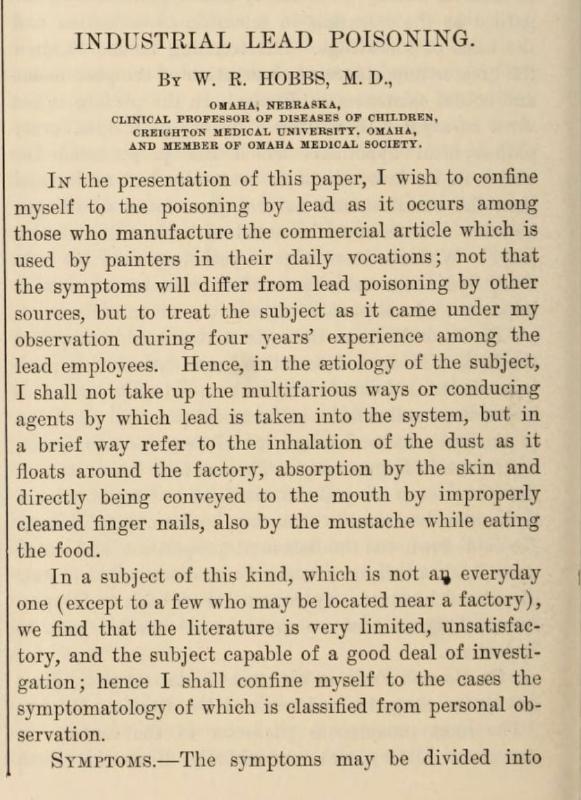
One of the earliest recorded medical articles on lead poisoning in Omaha came from Dr. W. R. Hobbs in 1898. Hobbs, an Omaha physician, published an article after spending four years treating workers from a local white-lead factory (Carter White Lead). In this article, he documented 34 severe cases among employees, compared with only eight mild cases during that period. His findings were important because they clearly described the common symptoms of industrial lead poisoning seen in Omaha’s workforce. Workers showed neurological problems such as limb weakness and “wrist drop,” a type of paralysis caused by damage to the nerves. They also suffered from physical symptoms like intense abdominal pain (“lead colic”), fatigue, pale skin, and muscle or joint pain symptoms that matched chronic lead exposure.
Hobbs’ article provided early clinical evidence showing that these neurological and gastrointestinal problems were directly connected to lead exposure in the factory environment. Hobbs’ 1898 article aligned with other late-19th-century reports of lead poisoning but showed the limits of medical thinking at the time. He warned doctors about risks to white-lead workers but avoided criticizing the factory conditions causing the exposure.
Hobbs’ failure to discuss workplace conditions such as dust, fumes, and rapid worker turnover reflected how occupational health functioned in the late nineteenth century. Historian Christopher C. Sellers, in Hazards of the Job, explains that doctors at this time had limited training in recognizing job-related hazards, so workplace illness was usually understood through symptoms rather than through any study of factory conditions. This context appears in Hobbs’ article. He mentioned that lead dust “floats around the factory” and described the medical literature on the subject as “very limited,” but he did not explore how these conditions shaped long-term health. He also noted that some areas of the factory had “more dust flying around than another,” yet his analysis remained focused on the cases he treated. His approach reflects the practical limits of medical knowledge at the time, when physicians worked with limited information and few tools for studying industrial exposure. In the end, he described the symptoms well but focused on treatment rather than advocating preventive industrial reforms.
New York Medical Journal. (1898). New York medical journal. A. R. Elliot. https://archive.org/details/newyorkmedicaljo6718unse/page/322/mode/2up?q=omaha+
Sellers, C. C. (1997). Hazards of the job. University of North Carolina Press.